Publication in Toronto of a Collective Volume on Canadian National Security, with a Chapter Examining the Digital Targeting of Morocco

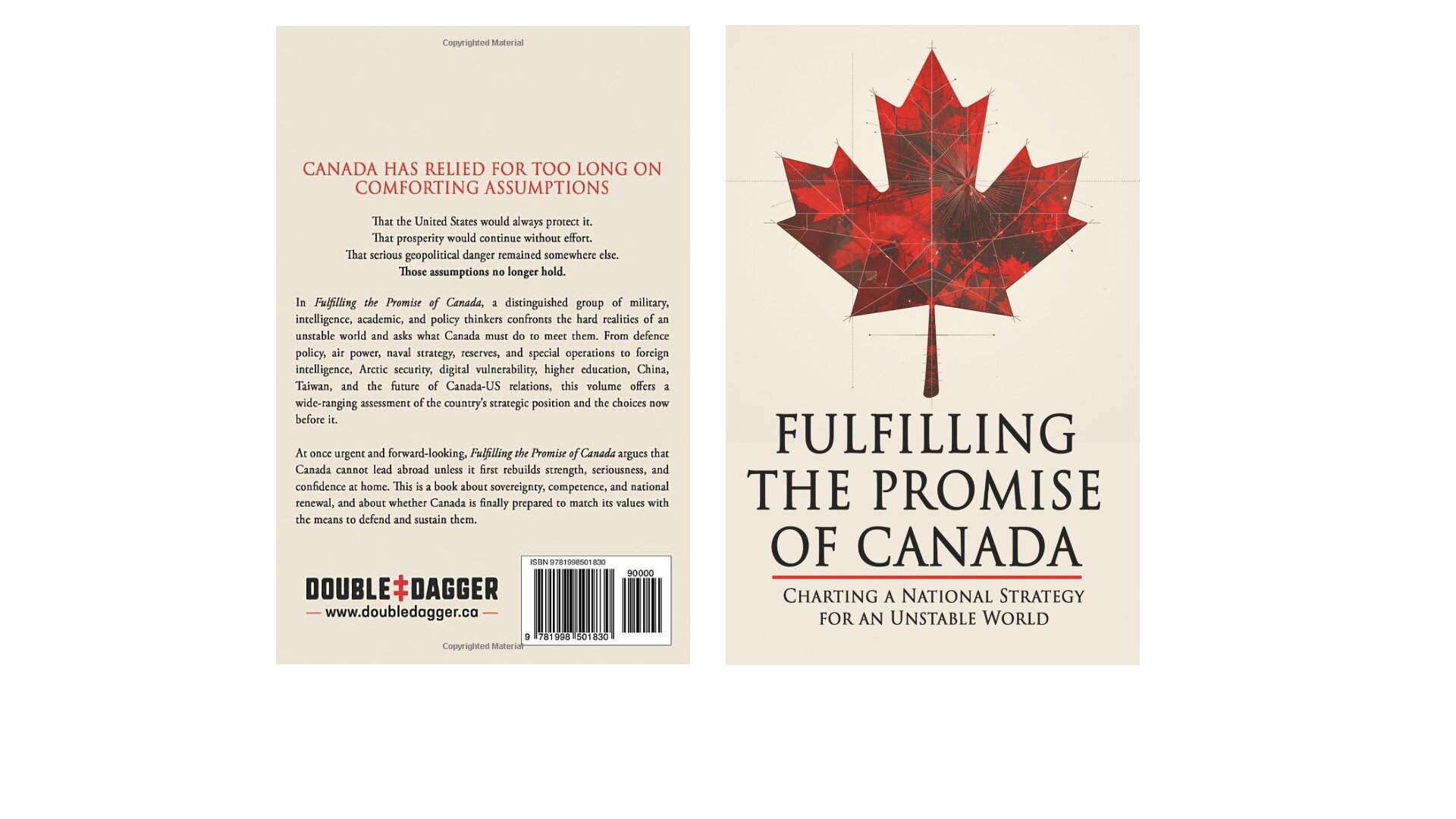
A new English-language collective volume, Fulfilling the Promise of Canada: Charting a National Strategy for an Unstable World, has been published in Canada. The book offers a structured intellectual contribution to the ongoing Canadian debate over the need to rebuild a more coherent national strategy in a world that has become more unstable, more competitive, and increasingly costly in terms of security, political, and technological risks.
Published on April 22 by Double Dagger Books Ltd. in Toronto, the volume is edited by Charles Oliviero, a retired Canadian Armed Forces colonel and specialist in military history and strategy, and Phil Halton, a retired lieutenant-colonel in the Canadian Army and an author focused on war and security issues.
The project was also produced under the auspices of RUSI-NB and RUSI Victoria, two Canadian branches linked to the Royal United Services Institute, the venerable British defence and security think tank founded in 1831.
The collective volume is built around a central idea. Canada can no longer manage its place in the world, or its national security, through the same intellectual frameworks that shaped the previous period. This includes the country’s near-automatic reliance on the American security umbrella, the assumption of a stable North American economic and political environment, and the belief that existing structures are sufficient to absorb new threats.
From this perspective, the book is divided into two broad sections. The first deals with military and defence issues, ranging from the navy, continental defence and air power to the reserves, special forces, military colleges, the senior chain of command and the modernization of the armed forces. The second addresses wider questions related to national identity, foreign intelligence assessment, universities, relations with China, North American defence, digital vulnerabilities, Canada-U.S. relations and the Taiwan question.
The book brings together contributions from retired generals and senior Canadian Army officers, academics, former officers and experts in security, intelligence and international relations. This gives the volume a distinctive character, combining operational experience with strategic analysis.
Within this broader framework, the chapter by Daniel Robson, an independent Canadian journalist and columnist specializing in extremism, terrorism, foreign interference and transnational crime, stands out in the second section under the title Canadian Digital Openness: Risks of Middle Power Credibility Erosion.
The chapter devotes significant attention to cases involving the targeting of Morocco from within the Canadian digital space, including the GenZ212 file and the case of Hicham Jerando. These cases are examined within a broader argument about the cost of digital openness for Canada’s credibility as a middle power.
The chapter shifts the debate away from traditional defence tools and toward the digital space as a strategic arena in its own right. Robson’s starting point is that Canada’s digital and legal openness, long presented as one of the country’s assets in terms of power, attractiveness and international legitimacy, can become a point of vulnerability in an environment of hybrid threats when it is exploited by hostile actors, extremist networks or transnational operators.
According to the chapter, the danger is not limited to domestic harm. It also affects Canada’s credibility as a middle power. When Canadian digital platforms or legal protections available on Canadian soil become spaces enabling propaganda, transnational intimidation, influence campaigns or reputational laundering under the cover of seemingly civil, media or activist activities, the issue also touches Canada’s image among its partners and its ability to defend abroad the norms it claims to uphold.
The text focuses in particular on the GenZ212 file, which it presents as a digital mobilization that targeted Morocco and, according to its analysis, moved beyond ordinary political commentary toward agitation associated with disorder and explicit calls for violence. The chapter also points to indicators suggesting that part of this digital activity was managed from Canada. It presents the case as an example of how the Canadian digital space can become a platform for operations with direct external effects.
The chapter also examines the case of Hicham Jerando, presented as another example of transnational digital activity operated from Canada. In its analysis, the text links this case to content involving antisemitic rhetoric, glorification of violence and the dissemination of narratives aligned with the Iranian ecosystem. It also refers to open-source elements connecting part of the activity to an earlier period during which some of Jerando’s pages were allegedly managed from Iran before later shifting toward Canada.
The chapter adds that this case has also been associated with digital intimidation and electronic extortion, making it, according to the author, a revealing example of the intersection between propaganda, intimidation and transnational pressure exercised through digital platforms.
Robson, however, does not limit his argument to these two cases. He connects them to other types of risks that may benefit from Canada’s open environment. The chapter refers to the case of Patrick Gordon MacDonald, known by the pseudonym Dark Foreigner, to show that the Canadian space can also be used to produce propaganda content linked to transnational terrorist and extremist milieus.
It also addresses findings from Canada’s federal assessment of money laundering and terrorist financing risks, particularly the existence of domestic support linked to listed entities such as Babbar Khalsa International and the International Sikh Youth Federation, within the broader environment of transnational Sikh extremism of Indian origin. The text therefore stresses that the issue is not limited to digital content, but also concerns support and facilitation functions that can affect Canada’s image among its partners.
One of the major angles developed in the chapter is what Robson calls the “linguistic blind spot.” According to him, some of the most dangerous forms of propaganda, intimidation and influence operate in Arabic, Persian, Russian and other languages. This can allow high-risk content to circulate for long periods before being detected, documented or connected to its networks of origin.
The chapter argues that this gap is not merely a technical or administrative weakness. It can also become a burden for foreign policy when it allows structured actors to exploit the least monitored and least analysed spaces.
Following the same logic, Robson argues for the need to restore the transnational context in the assessment of certain hostile digital activities conducted from Canada. He begins from the observation that a number of actors do not begin their trajectory on Canadian territory, but arrive there with prior records, networks and extensions linked to other spaces.
The chapter thus connects the need for a more rigorous Canadian law-enforcement framework with the importance of disciplined international cooperation. Such cooperation, it argues, can help complete the overall picture and improve assessment without compromising Canadian standards of evidence and procedure.
It is in this context that the chapter recalls Canada’s presence at the 93rd INTERPOL General Assembly in Marrakech, where member states discussed transnational crime and the growing threats circulating through international networks and platforms.
From there, Robson draws on the remarks of Abdellatif Hammouchi, Director General of National Security and Territorial Surveillance, who stated during the forum that security had become “global and indivisible,” and that transnational threats grow stronger when gaps persist between legal jurisdictions, coordination mechanisms and information-sharing systems.
The chapter uses this idea as an interpretive framework to support the call for a more coherent Canadian approach, based on law enforcement, multilingual analysis, intelligence assessment and structured international cooperation.
The chapter concludes that the challenge facing Canada does not lie in retreating from democratic openness, but in managing that openness as a strategic asset requiring protection and oversight. An open democracy, the text argues, retains its strategic value only if the state has the legal, institutional and operational tools needed to prevent it from being turned into an easily exploitable platform for hostile influence campaigns, violent propaganda and transnational intimidation.
Ultimately, Daniel Robson’s chapter places the digital dimension at the centre of the Canadian strategic question and clearly raises a problem that is no longer marginal in the Western security debate. How can a country such as Canada preserve its international image and credibility if its legal and digital openness remains vulnerable to exploitation by networks of influence, extremism and transnational crime?
That is precisely where the importance of this chapter lies within a volume that, as a whole, seeks to redefine the meaning of Canadian national strategy at a time when the nature of threats has changed, their spaces have expanded, and they are no longer confined to geography, military equipment or traditional balances of power.